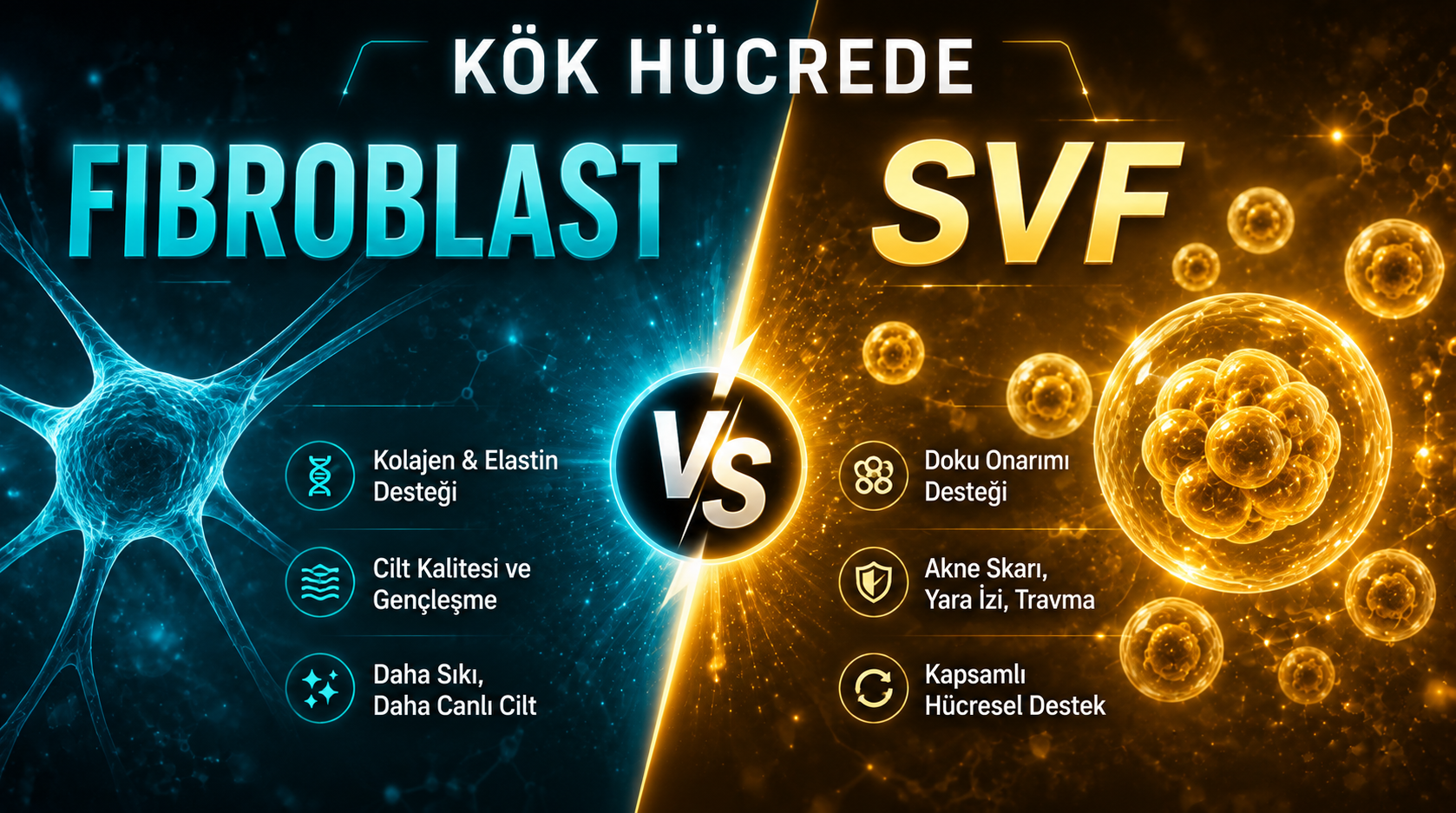
Fibroblast vs SVF: Which Cellular Treatment May Be Considered and When?
Fibroblast and SVF are not the same treatment. Fibroblasts mainly support collagen, elastin and connective tissue. In contrast, SVF comes from the patient’s own fat tissue and contains several different cell groups. Therefore, the key question is not “Which one is stronger?” but rather “What does the skin or tissue need?”
Why Are Fibroblast and SVF Often Confused?
People who research stem cell treatment often see fibroblast and SVF mentioned together. However, these two approaches do not have the same biological structure. For this reason, it is not accurate to describe fibroblast and SVF as two names for the same treatment.
Fibroblast applications mainly aim to support connective tissue and skin quality. In addition, fibroblasts play an important role in collagen and elastin production. SVF, on the other hand, comes from the patient’s own fat tissue and contains several different cell groups.
As a result, doctors do not choose a treatment only by its name. Instead, they assess the patient’s skin quality, current problem and need for tissue repair. Therefore, fibroblast and SVF may serve different purposes in different patients.
What Is the Main Difference Between Fibroblast and SVF?
The main difference between fibroblast and SVF lies in their cellular structure. A fibroblast is one of the main cells found naturally in connective tissue. It also plays an important role in collagen and elastin production.
SVF does not consist of a single cell type. Instead, it contains several cellular components obtained from the patient’s own fat tissue. Therefore, doctors consider SVF a broader cellular mixture.
What is the main role of fibroblasts?
Fibroblasts mainly support the structure of connective tissue. They also contribute to collagen and elastin production. Therefore, these cells play an important role in skin quality and elasticity.
What is the main feature of SVF?
SVF contains different cell groups. As a result, it does not have only one biological role. For example, doctors may consider it when tissue repair needs more support.
Fibroblast: Mainly focuses on supporting connective tissue, collagen, elastin and skin quality.
SVF: Contains several different cellular components and may be considered when broader tissue support is needed.
Is Fibroblast Really a Stem Cell?
People often search for fibroblast treatment using the phrase “fibroblast stem cell treatment.” However, fibroblasts are not the same as classic multipotent stem cells. Therefore, it is important to separate these terms correctly.
A fibroblast is a main cell of connective tissue. It also contributes to collagen and elastin production. Stem cells, by contrast, have a stronger ability to renew themselves and develop into different cell types.
So, fibroblasts are extremely important for skin structure. However, this does not make them identical to classic stem cells. In short, fibroblast and SVF have different biological characteristics.
What Do Fibroblasts Do in the Skin?
Healthy-looking skin depends on more than the surface layer. The deeper connective tissue also plays an important role in firmness and elasticity. Fibroblasts are among the key cells that support this tissue.
Collagen and elastin production
Fibroblasts support collagen production. They also contribute to elastin production. As a result, fibroblast activity closely relates to the strength and elasticity of the skin.
What changes with ageing?
As we age, fibroblast activity may change. This process can contribute to loss of elasticity and fine wrinkles. Therefore, fibroblast treatment mainly aims to support the quality of the skin’s connective tissue.
- Supporting collagen production
- Contributing to elastin production
- Supporting connective tissue
- Helping improve overall skin quality
When May Fibroblast Treatment Be Considered?
Doctors may consider fibroblast treatment especially in patients without major tissue damage. For example, imagine a patient in their 40s who does not have a significant skin disease. Their main goal may simply be to improve skin quality.
When skin quality has decreased
If the main concern is loss of elasticity and early ageing signs, fibroblast treatment may be considered. In addition, the patient may not have severe scarring or tissue damage caused by trauma. Therefore, the goal focuses more on supporting existing skin quality than repairing major tissue damage.
Which goals may suit fibroblast treatment?
- Supporting skin quality
- Supporting skin elasticity
- Supporting collagen production
- Improving the appearance of early ageing signs
- Supporting a healthier and more refreshed skin appearance
In short, fibroblast treatment may be more relevant when skin quality support is the main goal rather than extensive tissue repair.
What Is SVF?
SVF stands for Stromal Vascular Fraction. Doctors obtain it from the patient’s own fat tissue. For this reason, patients often search for it using terms such as “stem cells from fat” or “stem cells from your own fat.”
However, SVF does not contain only one type of cell. Instead, it includes different cell groups with different functions. Therefore, it is easier to think of SVF as a cellular mixture rather than a single-cell treatment.
Why is SVF different from fibroblast treatment?
Fibroblast treatment focuses on a more specific cell group. SVF, by contrast, contains several cellular components. Therefore, its potential clinical use may be broader in selected patients.
What is the main goal of SVF?
Doctors may consider SVF when tissue repair needs more support. In addition, it may offer a different option in patients with more complex skin concerns. However, this does not mean every skin problem requires SVF.
When May SVF From Your Own Fat Be Considered?
Doctors may consider SVF when the problem involves more than simple age-related skin quality loss. For example, some patients with acne scars or tissue changes after trauma may need more repair support. Therefore, the doctor may evaluate a broader cellular approach.
Acne scars and tissue irregularities
Acne scars can involve deeper layers of the skin. However, not every acne scar is the same. For this reason, doctors must first assess the type and depth of the scar.
Trauma and scar tissue
Trauma can change the structure of the tissue. In addition, scarred areas may require a different level of repair support. Therefore, SVF may become one of the options in selected patients.
Photo-ageing and more advanced tissue loss
Sun damage may gradually affect skin quality. However, more advanced wrinkles or tissue loss may require a broader evaluation. For this reason, doctors may consider SVF in some patients.
- More noticeable acne scars
- Advanced loss of tissue quality
- Tissue changes after trauma
- Scar tissue
- Significant photo-ageing
- Conditions where tissue repair is a major goal
Not every skin problem requires SVF. Instead, the doctor should assess the type of problem, its depth and the patient’s skin structure. Therefore, treatment selection should always remain individual.
Fibroblast or SVF: How Is the Right Treatment Chosen?
Age alone does not determine the right treatment. For example, a younger patient may have significant tissue damage. In contrast, an older patient may still have relatively healthy skin.
If the main concern is ageing
If the main problem is fine wrinkles and reduced elasticity, fibroblast treatment may be considered. In addition, the skin should not show major scar or trauma-related damage. Therefore, the goal focuses mainly on supporting connective tissue.
If the skin requires more repair
If the patient has acne scars, trauma-related changes or significant tissue damage, SVF may become an option. However, doctors do not base the decision on only one finding. They also assess overall skin quality and previous treatments.
Healthy skin with age-related quality loss: Fibroblast may be considered.
Skin with a stronger need for tissue repair: SVF may be considered.
Is SVF Stronger Than Fibroblast?
It is not accurate to describe one treatment simply as stronger or weaker. Fibroblast and SVF have different cellular structures and different clinical goals. Therefore, success depends on choosing the right approach for the right patient.
For example, fibroblast treatment may be enough for a patient without major tissue damage. In contrast, a patient with a more complex repair need may require a different approach such as SVF. Therefore, a more complex cellular structure does not automatically mean a better treatment.
In short, the two methods are not competitors. They respond to different needs. For this reason, the best option changes from patient to patient.
Fibroblast vs SVF: Key Differences
Fibroblast
Fibroblast treatment mainly aims to support connective tissue and skin quality.
- Supports collagen production
- Contributes to elastin production
- Supports skin quality
- May be considered for age-related skin changes
SVF
SVF contains different cellular components obtained from the patient’s own fat tissue.
- May support tissue repair
- May be considered in selected acne scar cases
- May be considered after trauma-related tissue changes
- May offer an option for more complex tissue concerns
Fibroblast or SVF for Skin Rejuvenation?
Doctors should not use the same treatment for every patient who wants skin rejuvenation. Ageing develops differently in each person. Therefore, the doctor must first identify the main skin concern.
Mild to moderate loss of skin quality
If the skin remains generally healthy, fibroblast treatment may be considered. In addition, the main goal may involve improving elasticity and skin quality. Therefore, a focused approach may be enough when major tissue repair is not necessary.
More complex skin problems
If the patient has scars, trauma-related changes or more significant tissue problems, SVF may be considered. However, some patients may also need other treatments. For this reason, the doctor should not base the entire treatment plan on one procedure.
Fibroblast or SVF for Acne Scars?
An acne scar is not only a surface colour change. Deeper tissue may also become affected, especially in depressed acne scars. Therefore, the doctor should first assess the structure of the scar.
Is SVF alone enough?
Not always. For example, laser treatments or microneedling may also be necessary. In addition, selected patients may benefit from SVF as part of a broader tissue repair plan.
Which factors matter in acne scar treatment?
- Type of scar
- Depth of scar
- Extent of scarring
- Skin type
- Previous treatments
Therefore, the treatment plan should match the individual characteristics of the acne scars.
Why Is SVF Considered Separately in Conditions Such as Rosacea?
Rosacea is not simply a form of skin ageing. It may also involve redness, sensitivity and inflammation. Therefore, doctors need to evaluate it differently.
In addition, the current activity of the condition matters. Doctors should also consider medication use and skin sensitivity. As a result, the role of SVF in rosacea deserves a separate discussion.
For more detailed information, you can read: Stem Cell Treatment (SVF) for Rosacea .
Can Fibroblast and SVF Be Used Together?
Fibroblast and SVF do not always replace each other. Some patients may have more than one skin concern at the same time. Therefore, doctors may consider the two approaches at different stages of a treatment plan.
When may a combined approach be considered?
For example, a patient may have both general skin quality loss and a separate area that requires tissue repair. In such a case, the doctor may consider different methods within the same overall plan. However, every patient does not need a combination treatment.
Does more treatment mean better treatment?
No. Doctors should avoid unnecessary procedures. Therefore, the goal is not to perform more treatments but to choose the right treatment.
Why Is Personalised Planning Important in Stem Cell Treatment?
Stem cell treatment is a broad term. However, fibroblast and SVF are not the same method. Therefore, doctors need to assess the patient’s individual features before planning treatment.
What does the doctor evaluate?
- Patient’s age
- Overall skin quality
- Degree of tissue damage
- Current skin problems
- Presence of scars or trauma
- Previous treatments
- Patient expectations
This approach prevents treatment selection based only on popularity. Instead, the doctor chooses the method according to the patient’s actual needs. As a result, personalised planning may also help avoid unnecessary procedures.
Dr. Emre Güvercin Explains the Difference Between Fibroblast and SVF
In the video at the beginning of this article, Dr. Emre Güvercin explains the difference between fibroblast and SVF using clinical examples. He also discusses which approach may be considered for different patient profiles. Therefore, the video offers a simple way to understand how these two treatments differ.
Questions answered in the video
- What is a fibroblast?
- Is fibroblast a stem cell?
- What is SVF?
- What does “stem cells from your own fat” mean?
- What is the main difference between fibroblast and SVF?
- Which option may be considered for skin rejuvenation?
- Why may SVF be considered when tissue repair is needed?
- Is SVF stronger than fibroblast?
- Can fibroblast and SVF be used together?
Conclusion: Fibroblast and SVF Are Not Competing Treatments
There is no single answer to the question “Fibroblast or SVF?” Each patient has a different skin structure and a different need for tissue repair. Therefore, the most suitable approach varies from person to person.
Doctors may consider fibroblast treatment when the main goal involves connective tissue and skin quality support. In contrast, SVF has a broader cellular structure. Therefore, it may offer a different option when tissue repair becomes a more important part of the treatment plan.
In short, the right question is not “Which one is better?” Instead, the better question is “What type of support does this patient’s skin or tissue need?” For this reason, a medical evaluation should guide the final treatment choice.
Related Articles About Fibroblast, SVF and Stem Cell Treatments
After understanding the difference between fibroblast and SVF, you can explore each treatment in more detail. In addition, the related articles below can help you understand the purpose of each method. This way, you can compare the treatments within the correct clinical context.
Frequently Asked Questions
Are fibroblast and SVF the same thing?
No. A fibroblast is one of the main cells of connective tissue. In contrast, SVF contains different cellular components obtained from the patient’s own fat tissue.
Is fibroblast a stem cell?
People sometimes describe fibroblast treatment as a stem cell treatment. However, fibroblasts are not the same as classic multipotent stem cells. They mainly contribute to collagen, elastin and connective tissue support.
What is SVF?
SVF stands for Stromal Vascular Fraction. Doctors obtain it from the patient’s own fat tissue. In addition, it contains several different cellular components.
What does “stem cells from your own fat” mean?
People commonly use this phrase to describe SVF. However, SVF does not consist only of stem cells. Instead, it contains several different cellular components.
Which is better for skin rejuvenation, fibroblast or SVF?
If the main concern is reduced skin quality, fibroblast treatment may be considered. In contrast, SVF may offer a different option when the tissue requires more repair support. Therefore, the best choice depends on the individual patient.
Is SVF stronger than fibroblast?
No. It is not accurate to compare these approaches only in terms of strength. They have different biological structures and different clinical goals.
Which is preferred for acne scars, fibroblast or SVF?
The type and depth of the acne scar matter. For example, doctors may consider SVF in selected patients. However, laser treatment, microneedling or other methods may also be necessary.
Can fibroblast and SVF be used together?
Yes, doctors may consider both approaches in selected patients. However, not every patient needs a combination. Therefore, the doctor should make this decision after an individual assessment.
What is fibroblast treatment used for?
Doctors mainly consider fibroblast treatment to support connective tissue, collagen production and skin elasticity. It may also be considered in age-related loss of skin quality.
What is SVF used for?
Doctors may consider SVF in selected patients when tissue repair support is an important treatment goal. However, the final decision should depend on the patient’s skin structure and current problem.
Disclaimer: Results of any surgical or interventional procedure may vary from person to person. It is recommended to consult your physician for a detailed evaluation before the procedure.