


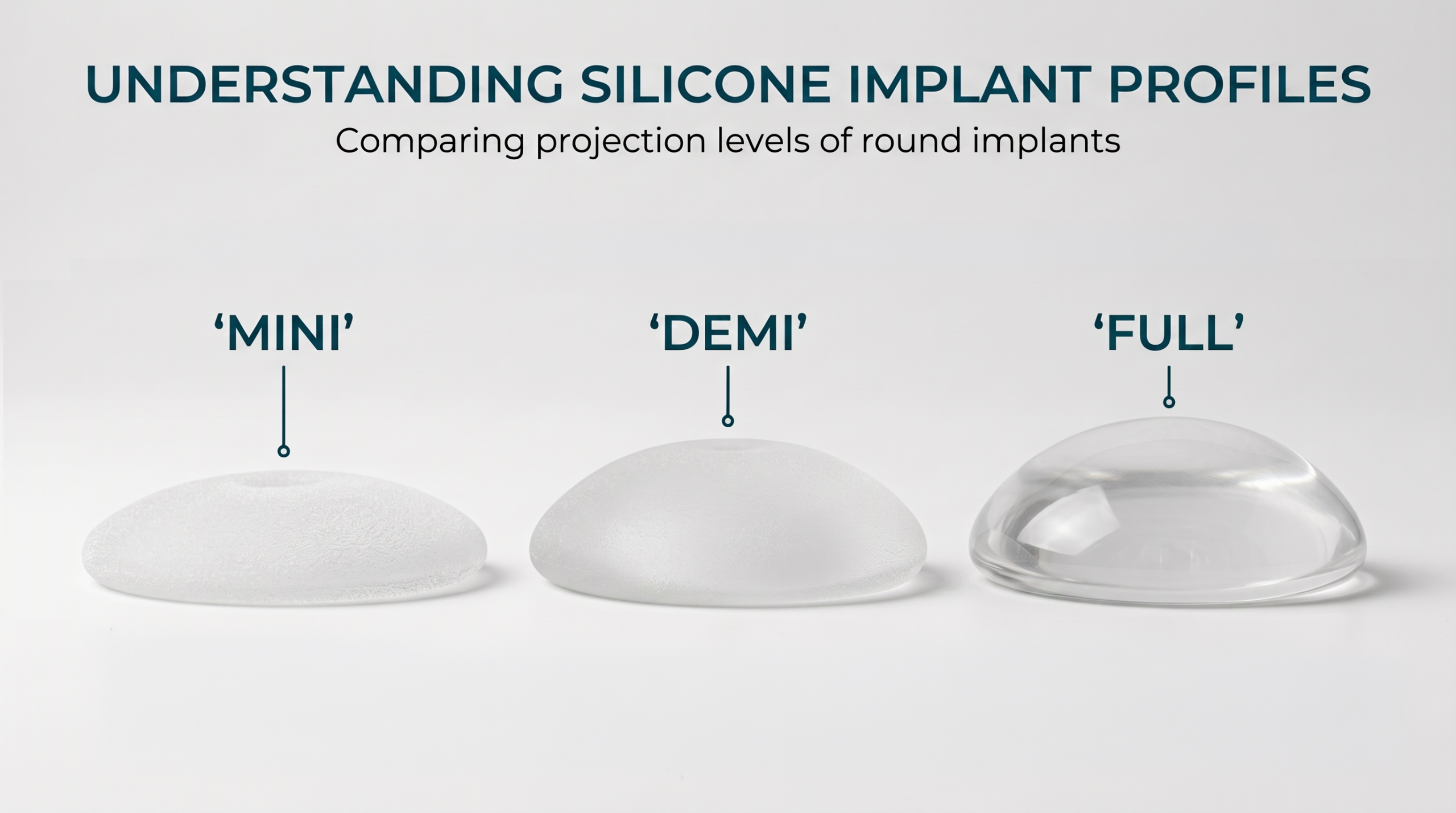
Breast Implant Selection: What Do Mini, Demi and Full Profiles Mean?
During breast implant selection, patients often come across terms such as Mini, Demi and Full implant profiles. They may wonder why two implants with the same volume can look different. They also often ask what changes between a 250 cc Demi implant and a 250 cc Full implant.
Implant volume alone does not determine the final appearance. Surgeons also consider the implant base width, projection, breast base, chest dimensions and existing breast tissue. These factors work together and help shape the surgical plan.
In the video above, Plastic, Reconstructive and Aesthetic Surgeon Dr. Emre Güvercin explains what Mini, Demi and Full profiles mean. This article expands on those points and explains how implant geometry can influence breast shape and projection.
Mini, Demi and Full describe different implant projection profiles. In simple terms, Mini offers lower projection, Demi offers moderate projection and Full offers higher projection. However, surgeons do not choose an implant by profile name alone. They also assess implant volume, base width and the patient’s anatomy.
Why Does Implant Profile Matter in Breast Implant Selection?
It helps to think of a breast implant as a three-dimensional shape. An implant has a base that sits on the chest and a height that extends forward from the chest wall.
Surgeons refer to this forward dimension as implant projection. When the implant profile changes, the same volume can spread across the chest in a different way.
Therefore, knowing the implant volume alone does not tell us exactly how an implant will look on the body.
What Is Breast Implant Projection?
Breast implant projection describes how far the implant extends forward from the chest wall. In other words, projection indicates how much forward height the implant can create.
When we view the breast from the side, projection plays an important role in how far the breast extends from the chest.
Mini: lower projection
Demi: moderate projection
Full: higher projection
These terms should not be interpreted simply as small, medium and large implants. Instead, they describe how the implant volume is distributed in three dimensions.
Why Can Breast Implants With the Same cc Look Different?
This is one of the most important points in implant planning: the same cc does not mean the same implant geometry.
For example, imagine two implants with a volume of 250 cc. A higher-projection implant may have a narrower base. If the same 250 cc volume is used in a lower-projection profile, the implant may have a wider base instead.
A 250 cc Full-profile implant may have a relatively narrower base and greater forward projection.
A 250 cc Demi-profile implant may distribute more of the same volume across a wider base. As a result, it may create less forward projection.
These figures are only used to explain the concept. Actual implant dimensions depend on the implant model and product range.
How Are Implant Base Width and Projection Related?
Implant base width and projection have a three-dimensional relationship. This becomes especially important when the implant volume remains the same.
If the same volume sits on a narrower base, the implant may project further forward. In contrast, when the same volume spreads across a wider base, the projection may decrease.
For this reason, saying “I want 250 cc” or “I want 300 cc” only answers one part of the planning process. The surgeon must also determine how that volume fits the patient’s breast base.
Is Breast Implant Selection Based Only on cc?
No. The cc value describes implant volume. However, the final appearance also depends on implant base width, projection and the patient’s anatomy.
Therefore, the same implant volume can create different results in two different patients. Likewise, two implants with the same cc but different profiles can look different on the same patient.
If you want to explore implant volume in the context of Preservé in more detail, read How Many cc Can Be Used in Preservé? . That article focuses specifically on volume and implant dimensions, while this article focuses on implant profile and projection.
What Is a Mini Breast Implant Profile?
A Mini profile refers to a lower-projection implant option. When a surgeon chooses lower projection at the same or a similar volume, the implant volume may spread across the chest with a different geometry.
However, it would be inaccurate to say that a Mini profile always looks more natural or always creates a smaller breast. Implant volume, base width, existing breast tissue and anatomy all influence the final appearance.
What Is a Demi Breast Implant Profile?
Demi generally refers to a moderate-projection profile. It provides more forward projection than Mini while offering less projection than a Full profile within the relevant implant range.
Again, Demi should not simply mean “larger.” Mini, Demi and Full implants with the same volume may have different base widths and projection measurements.
What Is a Full Breast Implant Profile?
A Full profile provides higher projection. Surgeons may consider it when the patient’s anatomy allows the selected base width and the surgical plan requires more forward projection.
Full does not automatically mean a very large implant. A lower-volume Full implant can still have a different projection from a higher-volume implant with a lower profile.
Are Implant Profile and Bra Cup Size the Same Thing?
Implant profile and bra cup size are not the same measurement. However, both relate in some way to breast fullness and forward projection.
In the video, Dr. Emre Güvercin uses A, B and C cup sizes as a simple analogy to make projection easier to understand. This does not mean that Mini always equals an A cup, Demi always equals a B cup or Full always equals a C cup.
Several anatomical factors influence cup size. The important point is that when a patient wants more forward fullness, projection becomes one of the parameters that the surgeon considers during breast implant selection.
Which Breast Implant Profile Is Best?
No single profile is better for every patient. The appropriate profile depends on the relationship between the patient’s anatomy and the desired breast shape.
During breast implant selection, surgeons may assess:
- Breast base width
- Chest dimensions
- The amount and distribution of existing breast tissue
- Implant base width
- Implant projection
- Implant volume in cc
- The patient’s desired breast shape and degree of fullness
For this reason, three-dimensional anatomical planning gives the surgeon more useful information than choosing an implant from the cc value alone.
Mini, Demi or Full: Which Profile Looks More Natural?
There is no single implant profile that always creates the most natural-looking result. A lower profile does not automatically look more natural. Likewise, a higher profile does not automatically look artificial.
Natural-looking proportions depend on how well the implant fits the patient’s breast anatomy and chest dimensions. A carefully selected Full profile may create a balanced result in a patient who needs more projection. In another patient, Demi or Mini may fit the anatomy more appropriately.
To explore this subject from the perspective of tissue-preserving breast augmentation, read Does Preservé Breast Augmentation Look Natural? .
Can Fat Transfer Be Combined With Preservé?
After discussing implant profiles, the video also addresses another common question: when can surgeons consider fat transfer together with Preservé?
Dr. Emre Güvercin explains that he does not primarily use fat transfer simply to increase breast size. Instead, he may use it as a complementary shaping tool in selected anatomical situations.
For example, some patients naturally have a wider space between the breasts. In selected cases, the surgeon may add fat transfer to create a more balanced visual transition toward the inner breast area.
Fat transfer may also play a role in selected tubular breast cases. Some patients have a short distance between the nipple and the inframammary fold or limited curvature in the lower pole. In these situations, the surgeon may combine the implant with fat transfer to support contouring and improve tissue distribution.
However, not every Preservé patient needs fat transfer. Patient selection remains essential. For more information, read Who Is Preservé Suitable For? .
The Better Question Is Not Only “How Many cc?” but “Which Geometry?”
It is understandable that patients often focus on implant volume first. Still, breast implant planning does not treat volume, base width and projection as isolated measurements.
Two implants can both be labelled 250 cc. Yet, if their profiles differ, their base widths and forward projection can also differ. Therefore, they do not necessarily create the same breast shape.
The simplest way to understand Mini, Demi and Full is this: cc tells us how much volume the implant contains, while the profile helps explain how that volume is distributed in three dimensions.
Frequently Asked Questions About Breast Implant Selection
What is the difference between Mini, Demi and Full breast implants?
The main difference is projection. In simple terms, Mini offers lower projection, Demi offers moderate projection and Full offers higher projection. Surgeons also consider volume, base width and patient anatomy before choosing an implant.
Will a 250 cc Demi implant look the same as a 250 cc Full implant?
Not necessarily. Both implants may contain 250 cc of volume, but their base widths and projections may differ. As a result, they can create a different appearance on the breast.
Does a Full profile mean a larger breast implant?
No. Full describes the implant’s projection profile rather than its volume alone. A higher-projection implant does not have to contain more cc than a lower-profile implant.
What matters more: implant cc or implant profile?
Surgeons do not choose implants by only one of these measurements. They assess volume, base width and projection together and match them to the patient’s anatomy.
Does implant profile determine bra cup size?
Not directly. Projection can influence forward fullness, but cup size also depends on existing breast tissue, chest dimensions and other anatomical factors.
Which breast implant profile looks the most natural?
There is no universal answer. A natural-looking result depends on how well the implant profile, base width and volume fit the patient’s anatomy and aesthetic goals.
Can Preservé breast augmentation include fat transfer?
In selected patients, the surgeon may add fat transfer as a complementary contouring method. The need for fat transfer depends on breast anatomy and the individual surgical plan.
Related Articles About Breast Implants, Preservé and MIA
If you want to understand whether the technique may be suitable for different breast anatomies, read Who Is Preservé Suitable For? . For a separate discussion of implant volume and dimensions, see How Many cc Can Be Used in Preservé? .
For an overview of the procedure, tissue-preserving concept and surgical approach, read Preserve Breast Augmentation: What Is Preservé™? .
You can also explore the technique in more detail in Ergonomix 2 Implant in Preservé .
If your main question is how Preservé relates to natural-looking breast augmentation, read Does Preservé Breast Augmentation Look Natural? .
For another detailed Preservé breast augmentation resource, see When Can You Exercise After Preservé Breast Augmentation? . This article focuses specifically on recovery and return to exercise rather than implant profile selection.
To compare different surgical approaches, read Differences Between Preservé and Classic Breast Augmentation Surgery .
You can also review the following Preservé resource: Preservé Breast Augmentation Recovery and Exercise .
For an introduction to the MIA approach, read What Is MIA Femtech Breast Harmonization? .
You can also review MIA Breast Augmentation for additional information about the technique.
For questions about long-term stability and the relationship between MIA and Preservé, read MIA & Preservé: Are the Results Permanent? .
If you want to compare MIA with conventional breast augmentation, read Differences Between MIA and Classic Breast Augmentation .
You can also explore Preservé Breast Augmentation and Breast Augmentation With the Preservé Technique to review the procedure from different perspectives.
Conclusion: How Is the Right Breast Implant Selected?
Mini, Demi and Full profiles help explain different levels of breast implant projection. However, the profile name alone cannot determine the most appropriate implant.
Surgeons assess implant volume, base width and projection together. They then compare those measurements with the patient’s breast base, chest anatomy, existing breast tissue and desired shape.
Therefore, instead of asking only “Should I choose 250 cc or 300 cc?”, it may be more useful to ask: Which implant geometry fits my anatomy and desired breast shape?
This content is intended for general informational purposes only and does not replace an individual medical consultation. Breast implant selection and surgical planning require a personal assessment of anatomy, medical history and expectations. Results of surgical and interventional procedures may vary from person to person.


