


NOTES FROM THE CLINIC · INTERNATIONAL KNOWLEDGE EXCHANGE
From South America to Istanbul: A Day of SVF and Micrograft Training
Highlights from our hands-on training day with Dr. Edwin Zara and his team at our clinic.
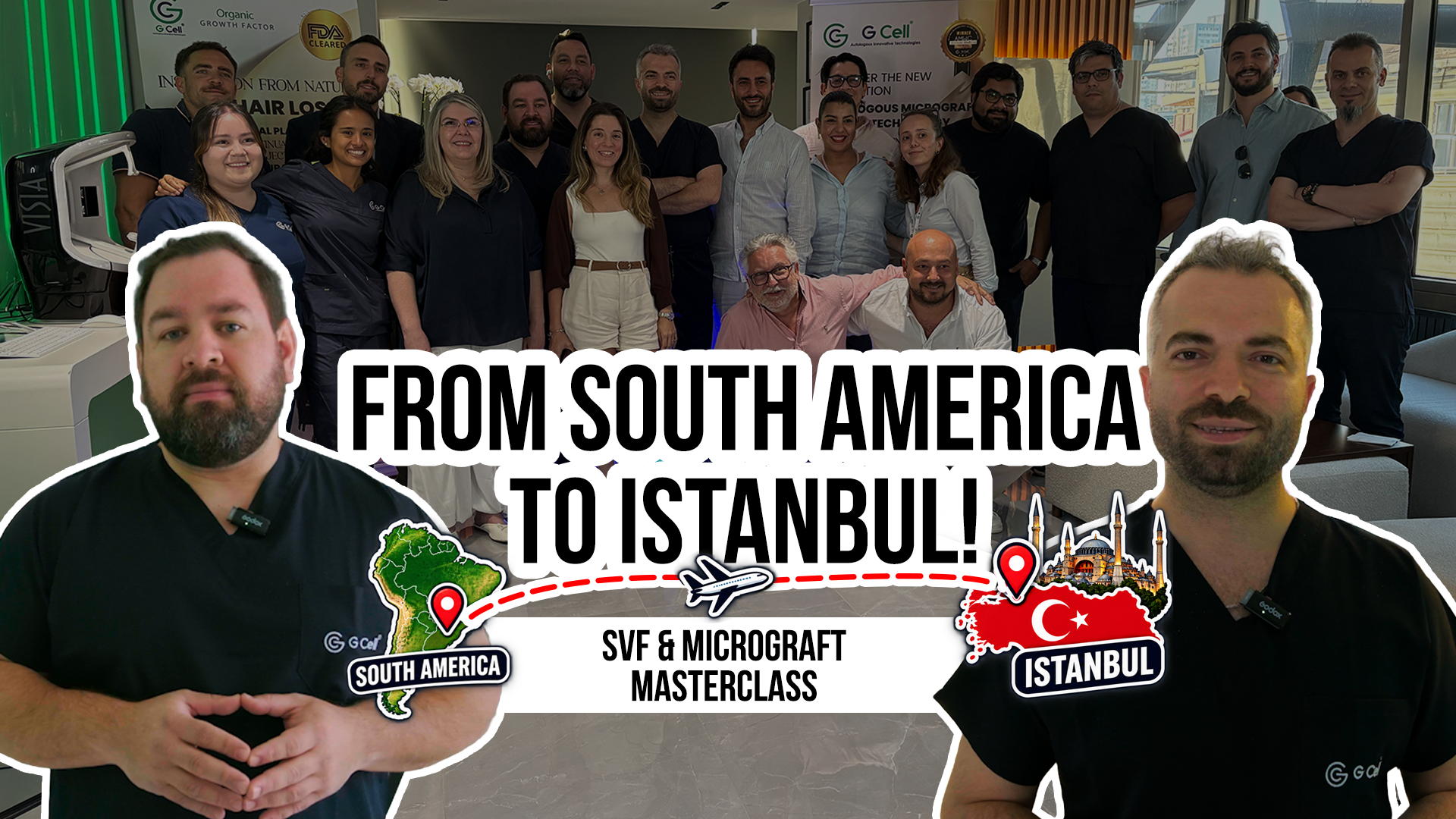
A few months ago, we welcomed Dr. Edwin Zara and his team from South America to our clinic in Istanbul for a visit organised by the GCell team. Dr. Emre Güvercin delivered hands-on SVF and micrograft training during a productive day of clinical practice and professional exchange.
We also documented the day in a vlog, bringing together the training atmosphere, the exchange of experience between teams, and two different approaches that use a patient’s own tissue. In this accompanying article, we share notes from the visit and explain the basic features of the SVF and micrograft procedures performed for hair treatment during the training.
What did the training day involve?
The GCell team organised the visit, bringing us together with Dr. Edwin Zara and his team to explore SVF and micrograft approaches. Dr. Emre Güvercin shared his clinical experience with both methods through hands-on training. The procedures performed during the day focused on hair treatment.
A Professional Visit from South America to Istanbul
Meeting colleagues from different countries in the same clinical setting creates a valuable opportunity to exchange experience. Dr. Edwin Zara and his team’s visit brought that exchange into everyday clinical practice.
During the visit organised by the GCell team, Dr. Emre Güvercin shared his experience with SVF and micrograft procedures. The training combined explanations of the methods with practical demonstrations in the clinic.
One of the highlights for us was bringing teams from different parts of the world together around a shared clinical interest. Our vlog captures that meeting within the daily rhythm of the clinic.
SVF and Micrograft Training: Sharing Clinical Practice
Hands-on training gives participants a closer look at how a method is used in a clinical setting. When theoretical knowledge is connected with practical demonstrations, the steps involved and the decisions behind them become easier to understand.
The procedures performed during this training day focused on hair treatment. The practical sessions explored the use of SVF and micrografts in this area.
Both approaches are described as “autologous” because they use the patient’s own tissue. However, this shared description does not mean that SVF and micrografts have the same composition or preparation process. Understanding their tissue sources helps explain the difference.
One of the Approaches Demonstrated: SVF for Hair Treatment
SVF stands for stromal vascular fraction. It refers to a fraction obtained from adipose tissue that contains different cell populations. Although patients may encounter the term “stem cells from your own fat,” SVF is not a preparation consisting solely of purified stem cells.
Research in hair treatment examines whether these adipose-derived cellular components can support the biological environment around hair follicles. Studies assess measures such as hair density, hair shaft thickness, and changes in hair loss over time.
However, the preparation methods and composition of products described as SVF can vary. Findings from one study therefore cannot be directly applied to every device or protocol.
What is the aim in hair treatment?
The aim is to assess support for existing hair and the scalp environment in suitable patients. SVF should not be described as a method that creates new hair follicles in everyone or permanently stops hair loss.
What Are Micrografts, and How Are They Used in Hair Treatment?
Autologous micrograft treatment for hair uses tiny tissue fragments prepared by processing small samples taken from the patient’s own scalp. The characteristics of the resulting material depend on the system and protocol used.
This approach makes use of the cellular and tissue components within scalp-derived micrografts. Clinical research investigates their potential contribution to the growth and density of existing hair.
This micrograft approach differs from hair transplantation. In a hair transplant, follicular units are taken from a donor area and placed in the recipient area. The approach discussed here instead uses material prepared from processed small tissue samples.
Treatment planning considers the condition of the scalp, the characteristics of hair loss, and the patient’s expectations. The physician then determines whether the approach is suitable and where it may fit within the treatment plan.
Two Different Tissue Sources Explored During One Training Day
Covering SVF and micrografts in the same training provides a useful opportunity to explain their main distinction: SVF is obtained from adipose tissue, while the micrograft approach used for hair treatment draws on scalp tissue samples.
| Feature | SVF | Micrografts |
|---|---|---|
| Tissue source | The patient’s own adipose tissue | Small samples taken from the patient’s own scalp |
| Basic composition | A fraction containing different cell populations, with composition varying by preparation method | Micrografts containing cellular components, obtained from processed tissue samples |
| Research focus in hair treatment | Potential effects on the scalp environment, hair density, and hair shaft thickness | Potential contribution to the growth and density of existing hair |
| Key planning considerations | The cause of hair loss, scalp condition, medical history, and realistic expectations | |
This distinction is more informative than ranking the methods according to which is “stronger.” The same procedure is not suitable for every patient, and the two approaches do not always need to be combined. Demonstrating both during one training day also does not mean that they were used together in the same patient.
Hair Treatment Begins with an Individual Assessment
Hair thinning may look similar in different people, but the underlying cause is not always the same. The type and duration of hair loss, the condition of the scalp, and previous treatments all influence planning. A clinical examination should therefore guide the choice of approach.
When considering SVF or micrografts, the physician assesses the existing hair alongside the patient’s expectations. Diagnostic investigations and other treatment options may also form part of the plan when appropriate.
Although clinical studies have reported encouraging findings, participant numbers, treatment protocols, and follow-up periods vary. Larger studies are needed to clarify long-term outcomes and identify which patients may benefit most.
When watching a training video, it is therefore helpful to distinguish the demonstration of a procedure from the patient’s response over time. This vlog documents the training day; it does not present a long-term outcome assessment.
Looking Back on a Productive Day
Welcoming Dr. Edwin Zara and his team to our clinic gave us an opportunity to share experience through an international professional exchange. Dr. Emre Güvercin’s hands-on SVF and micrograft training was at the centre of the visit.
With our vlog, we wanted to share this meeting through the story of a day at the clinic. You can watch the procedures shown in the video alongside the brief explanations in this article.
We thank Dr. Edwin Zara and his team for their visit and participation, and the GCell team for organising the training day.
Quick Answers About the Training and Procedures
Which procedures were performed during the SVF and micrograft training?
During the training delivered by Dr. Emre Güvercin for Dr. Edwin Zara and his team, SVF and micrograft procedures were performed for hair treatment.
Are SVF and micrografts for hair the same procedure?
No. SVF uses a fraction obtained from adipose tissue. The autologous micrograft approach for hair uses processed small scalp tissue samples. Their tissue sources and preparation processes differ.
Does micrograft treatment mean hair transplantation?
The micrograft approach described in this article differs from hair transplantation. A hair transplant moves follicular units to a recipient area, while this approach uses micrograft material prepared from small tissue samples.
Does the vlog show long-term treatment results?
This content documents the training day at our clinic. Long-term treatment response requires a baseline assessment and regular clinical follow-up.
Related Articles
Explore the following articles to learn more about other applications of SVF and how it relates to different cellular approaches.


