


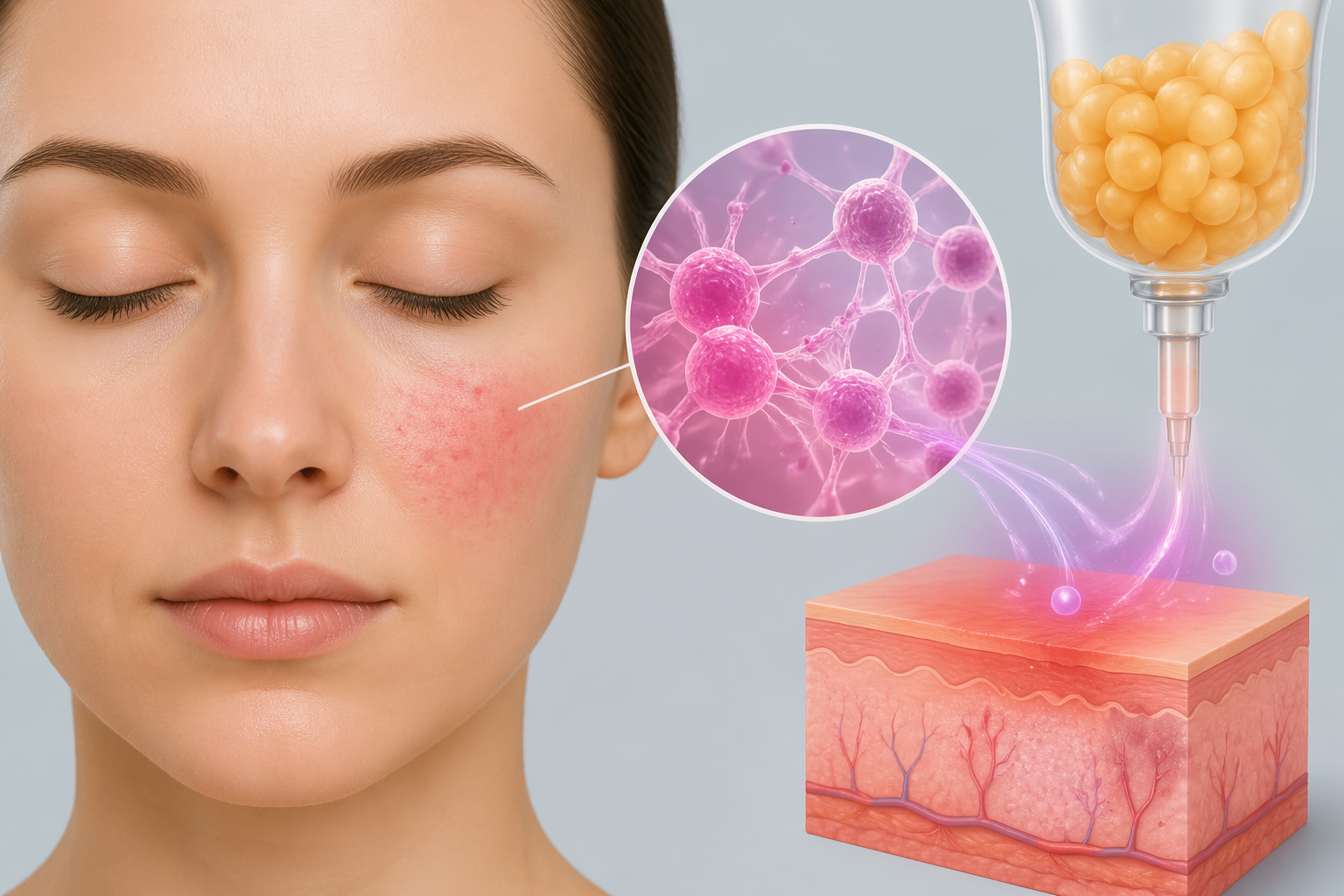
Rosacea Stem Cell Treatment (SVF): A Supportive Cellular Approach for Redness, Sensitivity, and Chronic Inflammation
Rosacea stem cell treatment using SVF offers a supportive cellular approach for patients who struggle with chronic redness, skin sensitivity, burning sensations, and ongoing inflammation. Moreover, rosacea rarely acts as a simple surface issue. Instead, it often reflects a deeper inflammatory process that affects both skin comfort and appearance. For that reason, SVF has become an important complementary option in selected rosacea treatment plans.
SVF contains a rich cellular mixture derived from the patient’s own adipose tissue. In rosacea treatment, this approach may help calm chronic inflammation. As a result, it may support the reduction of redness, sensitivity, burning, and visible vascular prominence. In addition, clinicians often evaluate SVF as part of a broader personalized treatment strategy rather than as a stand-alone solution.
What Is Rosacea?
Rosacea is a chronic skin condition that commonly affects the cheeks, nose, chin, and forehead. In many patients, it causes persistent or recurring facial redness. Furthermore, increased skin sensitivity, heat, burning sensations, and visible vessels may also appear during the course of the disease.
Rosacea does not only affect appearance. On the contrary, it may reduce daily comfort and create ongoing irritation in the skin. For example, heat, environmental triggers, and certain skincare products may intensify symptoms. Consequently, rosacea often requires long-term management rather than a one-time intervention.
Why Does Rosacea Treatment Focus on Symptom Control?
Rosacea does not have a single definitive cure that fits every patient. Therefore, treatment usually aims to control symptoms rather than eliminate the condition completely. In other words, the goal is to reduce redness, sensitivity, burning, and chronic inflammation and to make flare-ups easier to manage.
Today, physicians often use topical products, medical treatments, and laser applications in this process. However, chronic and recurrent cases usually benefit from supportive options as well. As a result, rosacea management often requires a layered and personalized treatment plan.
Why Does Stem Cell Treatment (SVF) Matter in Rosacea?
The main reason behind the growing interest in rosacea stem cell treatment lies in the inflammatory nature of the disease. Rosacea does not only create visible redness. At the same time, it drives inflammatory activity, vascular prominence, and an increase in skin reactivity.
At this point, SVF draws attention because it may support the skin at a cellular level. Additionally, its role in inflammation control makes it particularly relevant in chronic skin conditions such as rosacea. In short, clinicians use this approach to complement surface-based treatments with a deeper biological perspective.
What Is SVF?
SVF stands for Stromal Vascular Fraction. It is a cellular mixture obtained from the patient’s own adipose tissue. This fraction includes fat cells, stromal support cells, and mesenchymal stem cells. In addition, this cellular environment may support tissue balance and regenerative signaling.
Mesenchymal stem cells exist in high concentrations within adipose tissue and play a role in many biological processes. Because of that, SVF stands out as a personalized cellular option that may support inflammation control in selected rosacea patients. Likewise, the use of the patient’s own cells may reduce the risk of allergic reactions.
- It may help calm chronic inflammation
- It may support a reduction in redness and sensitivity
- It may help balance visible vascular prominence
- It uses the patient’s own cells and supports a personalized plan
How Can Stem Cell Treatment (SVF) Support Rosacea Management?
Stem cell treatment with SVF does not only target the surface of the skin. Instead, it aims to support the underlying cellular environment. In this way, the treatment may help reduce inflammatory activity and may support a calmer skin response over time.
When inflammation becomes more controlled, the skin environment may also stabilize. Thus, patients may see supportive improvement in redness, sensitivity, burning, and vascular visibility. Still, every patient has a different skin profile. For that reason, clinicians should evaluate the potential contribution of SVF on an individual basis.
Can Laser Treatments and SVF Work Together?
Yes, clinicians may combine these two approaches in suitable patients. Laser treatments play an important role in targeting redness and visible vessels. By contrast, SVF may support the deeper cellular side of the process.
In that setting, one method addresses the visible surface findings, while the other supports inflammation control at a cellular level. Therefore, the combination of laser treatment and SVF may create a more balanced and comprehensive rosacea management plan.
What Are the Advantages of Using SVF in Rosacea Treatment?
- It allows personalized treatment planning
- It uses the patient’s own cells, so it offers high biocompatibility
- It supports the treatment process at a cellular level
- It may complement laser and other supportive methods
Why Is This Article Different from the Main SVF Page?
This article does not repeat the broad question, “What is SVF?” Instead, it focuses specifically on how clinicians position stem cell treatment (SVF) in rosacea care. In other words, this page acts as a supporting article that targets a distinct clinical problem.
That structure also helps reduce content overlap across the website. At the same time, it creates a clearer topical separation for search engines. Consequently, the page can target more specific search intent without competing directly with the main SVF pillar page.
Conclusion: How Does SVF Fit into Rosacea Treatment?
Rosacea is a chronic skin condition marked by redness, burning, sensitivity, and ongoing inflammation. For that reason, treatment usually requires a multi-layered strategy. Within that strategy, stem cell treatment with SVF may serve as a supportive option because of its potential role in inflammation control at a cellular level.
When clinicians combine SVF with laser treatment in suitable cases, they may create a more comprehensive and personalized plan. However, patient selection remains essential. Ultimately, the physician should evaluate skin structure, clinical findings, and treatment goals before adding SVF to a rosacea management protocol.
Related Articles
👉 Learn more about stem cell SVF treatment
👉 Compare SVF with mesotherapy
Frequently Asked Questions
Is stem cell treatment (SVF) a permanent solution for rosacea?
Rosacea is a chronic condition. Therefore, treatment usually focuses on symptom control. However, clinicians may use SVF as a supportive option that aims to calm inflammation and improve overall skin comfort.
Why do clinicians consider SVF in rosacea treatment?
Clinicians consider SVF because rosacea involves an ongoing inflammatory process. As a result, a cellular approach that supports inflammation control may add value to a broader personalized treatment plan.
Can laser treatment and SVF be combined for rosacea?
Yes, clinicians may combine laser treatment and SVF in suitable patients. Laser treatment targets visible redness and vessels, while SVF may support the deeper cellular environment. The physician should always decide the plan according to individual needs.
The results of any surgical or interventional procedure may vary from person to person. It is recommended to consult your physician for a detailed evaluation before any procedure.


